



Facial aesthetics is one of the fastest-growing areas of private dentistry, and one of the easiest to get wrong in your online marketing. A single Instagram post mentioning Botox pricing, or a before-and-after photo shared without thinking, can put your practice in breach of advertising law. Think of it like a small cavity you can’t see: it doesn’t hurt yet, so it’s easy to leave alone. But by the time it’s flagged, whether by a patient complaint, an ASA sweep, or a competitor reporting you, it’s not a filling anymore. It’s a much bigger job. This isn’t a grey area that you can interpret generously; it’s a legal restriction with real enforcement behind it.
At The Creative Composite, we’ve spent 20+ years working inside the dental industry, which means we track this stuff closely and put it in plain English so that you don’t have to. This guide sets out exactly where the line sits for 2026, drawing on current guidance from the Advertising Standards Authority (ASA), the Medicines and Healthcare products Regulatory Agency (MHRA) and the General Dental Council (GDC).
Is it illegal to advertise Botox in the UK?
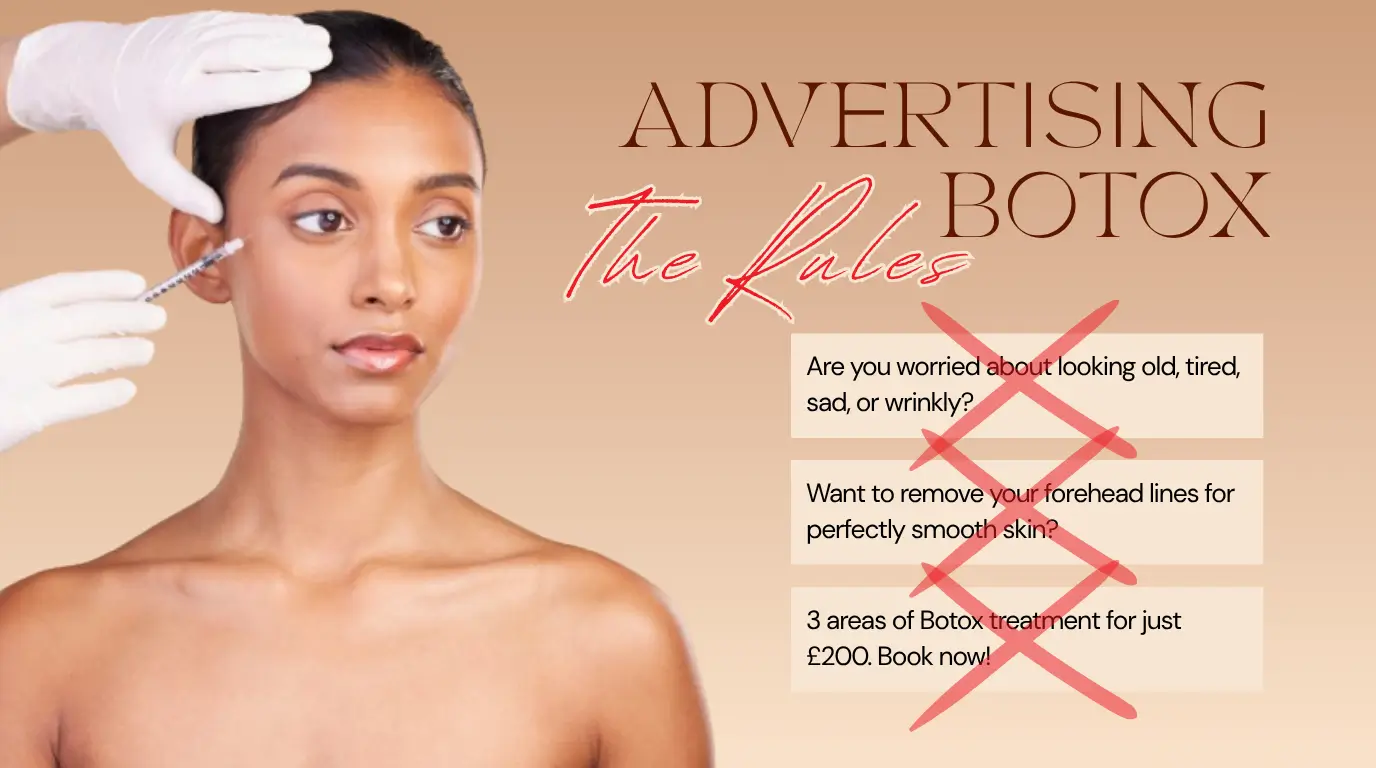
Yes. Botox is a prescription-only medicine (POM), and under the Human Medicines Regulations 2012, POMs cannot be advertised to the public in any form. This isn’t an ASA guideline you can push against with a well-written disclaimer; it’s UK medicines law, reinforced by CAP Code rule 12.12.
If you’re reading this wondering whether something you’ve already posted counts, you’re not alone; most practices have something live right now that technically breaks this rule, simply because no one told them where the line was. In simple terms, you cannot:
- Name Botox in a public-facing post, page or ad
- Show before-and-after images of anti-wrinkle treatment
- List pricing for anti-wrinkle injections
- Run paid social ads that mention the treatment, directly or through hashtags
It applies everywhere the public can see it: your website, Google Business Profile, Instagram, Facebook, TikTok, print, and even A-boards outside the practice. It makes no difference whether the content is organic or paid.
There’s a second, separate restriction worth knowing about too. Botox is a trademark owned by Allergan. Using the brand name in marketing without permission raises trademark issues on top of the medicines law problem, which is one more reason “anti-wrinkle injections” is the safer phrase to build your copy around internally, even though that phrase can’t be advertised either while it refers to a POM treatment.
Why can’t you say “Botox” on Instagram?
Practices ask this a lot, usually after finding a competitor’s post still live and wondering why the rules seem inconsistent. Two things are going on:
- Instagram is a public advertising channel, so the POM restriction applies in full. It doesn’t matter that the audience is patients who’ve already chosen to follow you; the ASA and MHRA treat social media the same as any other public ad space.
- Enforcement is complaint and pattern-led, not automatic. A post can sit live for months before it’s flagged, reported or picked up in a sweep. Seeing it hasn’t been taken down isn’t the same as it being compliant.
If a post names the treatment, shows results or gives pricing, it’s advertising a POM to the public, whichever platform it’s on.
What you can actually advertise
If you’ve got this far and you’re now wondering how you’re supposed to attract facial aesthetics patients at all, you’re in good company. Facial aesthetics treatments are one of the most in-demand treatments for practices that offer them, and yet the one thing patients search for by name is the one thing you can’t say. It feels like being asked to sell a service you’re not allowed to describe.
Fortunately, the restriction is specific to POMs, not to facial aesthetics as a category, and that distinction is where the opportunity lies. Several things stay well within the rules.
Dermal fillers. Fillers aren’t classed as a POM, so you can advertise them, provided the content is honest, not exaggerated and doesn’t overstate results. Any claims about outcomes need to be realistic and backed by evidence, and you should be upfront about risks and who’s carrying out the treatment.
Consultations. Both the ASA and MHRA are clear that you can promote the consultation itself, even where the eventual treatment involves a POM. This is the route most compliant practices lean on. Promote the expertise of the clinician, the thoroughness of the assessment, and the fact that patients get an honest conversation about what’s right for them, rather than a hard sell for a named injectable.
Education. General content about facial ageing, skin health or what to expect from a consultation is fine, as long as it stops short of naming or promoting a specific POM.
Patient testimonials on their own channels. If a patient posts about their own experience on their own social media, unprompted and unpaid, that’s user-generated content rather than advertising by the practice. Encouraging or incentivising it, however, pulls it back under your responsibility.
The consultation-first approach, done properly
Treating the consultation as the product, not the treatment, is what keeps most of this compliant. A few things matter here:
- Frame it as an assessment and education session, not a sales conversation
- Cover the full range of options, including non-POM treatments, so it doesn’t read as a route straight to one specific outcome
- Document everything, including that a cooling-off period was offered
- Never treat with a POM on the same day as the initial consultation
- Get explicit, recorded consent that shows the patient understands why certain treatments can’t be advertised to them beforehand
Done well, this isn’t a workaround. It’s a genuinely better patient experience, and it happens to be the version of facial aesthetics marketing that’s actually allowed. Beyond compliance, consultation-first approach doesn’t just keep you compliant, it naturally filters out the price-shoppers and tyre-kickers before they ever reach the chair. Patients who are willing to sit through a proper assessment are the ones who were serious about the treatment in the first place.
The 2026 regulatory picture: what’s changing
Non-surgical cosmetic procedures in England are moving toward formal licensing under powers in the Health and Care Act 2022. Following its 2023 consultation, the government confirmed in August 2025 that treatments will be sorted into three risk tiers (Green, Amber and Red), with Botox sitting in the Amber category alongside most facial fillers. In practice, this becomes a two-part system: Green and Amber procedures fall under local authority licensing, while Red-tier procedures (the highest risk) are brought under Care Quality Commission regulation and restricted to qualified healthcare professionals.
Rollout is happening in stages through 2026 and 2027, with further consultation on the highest-risk category still ongoing as of August 2026. The direction is clear even if the finer details are still being finalised, so treat any “final rules” claims you see with caution and check GOV.UK directly before making compliance decisions based on it. What’s already settled and enforceable today is the POM advertising restriction, the ASA’s targeting rules, and the GDC’s advertising standards, so that’s where your compliance effort should sit right now.
ASA rules and regulations at a glance
A few CAP Code rules come up repeatedly for practices offering facial aesthetics:
- Rule 12.12 – prescription-only medicines cannot be advertised to the public
- Rule 12.25 – cosmetic intervention ads (including injectables) cannot be targeted at under-18s, a restriction introduced in November 2021 and still in force
- Rule 12.9 – marketers can’t claim or imply a treatment is guaranteed, risk-free or side-effect free without proof
- Rule 3.7 / 12.1 – any claim you do make needs documentary evidence behind it, not just confidence
The ASA’s guidance also flags social responsibility expectations around cosmetic interventions, including avoiding language that trivialises the decision to have treatment or plays on appearance-related insecurity.
GDC compliance for dental professionals
Alongside the ASA and MHRA rules, GDC-registered professionals have their own advertising standard to meet (Standards for the Dental Team, 1.3.3): all promotional material must be accurate, not misleading, and legal, decent, honest and truthful. Practically, that means your GDC registration number should appear wherever you’re named as a provider, claims need to be backed by fact rather than implication, and nothing in your marketing should create an unjustified expectation about results. We’ve covered the full detail of GDC advertising compliance, including website requirements and specialist title rules, in a separate guide.
A practical checklist before you post
- Does this mention Botox, or imply it, anywhere in the copy, image or hashtags? If yes, don’t post it publicly.
- Is this about a consultation, education, or a non-POM treatment like fillers? Then it’s likely fine, provided claims are realistic and evidenced.
- Would a patient reading this expect a guaranteed result? If so, rewrite it.
- Is your GDC number visible wherever you’re named as the provider?
- Could this be seen by, or targeted at, under-18s? If there’s any doubt, restrict it.
Facial aesthetics is a genuine growth area, but it’s also the area where a single careless post can cost the most. Every piece of content we put out for dental practices, whether it’s a caption or an SEO landing page, is checked against this exact set of rules before it goes anywhere near a patient because we’d rather catch it here than have you find out from the ASA. That’s also why we lean hard into organic content and SEO for facial aesthetics: it reaches people already searching with real intent, rather than publishing paid ads at cold audiences.
If you want a second pair of eyes on what’s already live on your channels, or want to build out a facial aesthetics content plan that’s compliant from the first draft, book a call with Hassan.
This article is for general guidance and reflects our understanding of ASA, MHRA and GDC rules as of August 2026. It isn’t legal advice, and the non-surgical procedures licensing scheme in particular is still evolving, so always confirm current requirements with the relevant regulator before publishing.